Do you know that your daily work can become Eco-Friendly?
Switching to Bio Materials is a fundamental ethical choice.
Alessandro Cataldi, CEO of Larident and forerunner for Bio in the Dental field, tells us about it.
By 2050, Bio Materials could reduce greenhouse gas emissions from the manufacturing field by up to 40% and reduce plastic pollution in oceans and ecosystems.
Ellen MacArthur Foundation, an American foundation for the circular economy, predicts that by 2050, biodegradable plastic could represent 5-10% of the global plastics market.
McKinsey & Company, a global strategic consultancy firm, estimates that the biomaterials market could reach $640 billion by 2030, driven by demand for sustainable products.
The new needs of the market and the dental sector
The needs of the global market are changing. Interest in the environment, strategies to combat global warming, whether governmental or personal, the continuous search for personal and community well-being have brought us this far; Organic, eco-sustainable, low-impact alternatives to notoriously polluting products and materials are a reality that is and will continue to gain ground, both in the private and business sectors.
The dental sector will also undergo a small revolution: focusing on biomaterials and eco-sustainability will become increasingly important. An eco-friendly dental practice, for eco-dentistry professionals: this is our outlook.

Alessandro Cataldi, CEO of Larident and forerunner in the research of Bio materials in the dental field, tells us about his experience.
What are Biomaterials?
Bio Materials are a category of materials that interact with biological systems in a favourable way. They are materials designed to be compatible with “life” (bios), i.e. living cells or microorganisms. To give some examples, the best-known biomaterials are titanium, stainless steel, hydroxyapatite, bio-ceramics and PLA.
The first products with biomaterials
In 2012 I was asked to create a tray in an eco-sustainable material: it seemed like an exciting challenge and I liked the idea of delving into this area which, at the time, I already considered stimulating and with a lot of potential.
We opted for PLA, a biopolymer now in common use, used especially in 3D printing, deriving from renewable organic resources such as corn, beets and other vegetables. PLA is a material with high mechanical resistance, similar to that of the better-known PET (the plastic commonly used for packaging) but biodegradable in certain conditions and industrially compostable. This material was exactly what we needed.

So we created this prototype Bio tray in PLA, with a thickness of 0.25mm. It was a surprising process to create an object that we commonly know is made of plastic in a biocompatible, compostable, biodegradable material that also responded to the needs of its use; a real utopia, the future was knocking on Larident’s door!
It came with costs: making this tray cost four times more than a common PET or polystyrene tray.
Not exactly the best thing.
But there was also another problem: the average person at the time didn’t know the meaning of “compostable” or “biodegradable”.
It was necessary to wait for the right moment and educate ourselves about Bio Materials
Today we know that compostable refers to a material which, after degrading, is transformed into compost, a substance rich in nutritional properties used as a fertilizer to enrich arable land.

European legislation tightens the meaning of compostable even further: a biomaterial is compostable if it degrades in the environment within just three months.
A biodegradable material, on the other hand, has longer degradation times, returning to the earth in the form of mineral salts and other simple elements.

Therefore, to be defined as compostable waste, it must necessarily be biodegradable, while a biodegradable material may not be compostable.
The investment in these new eco-sustainable materials was necessary, for us and for the planet
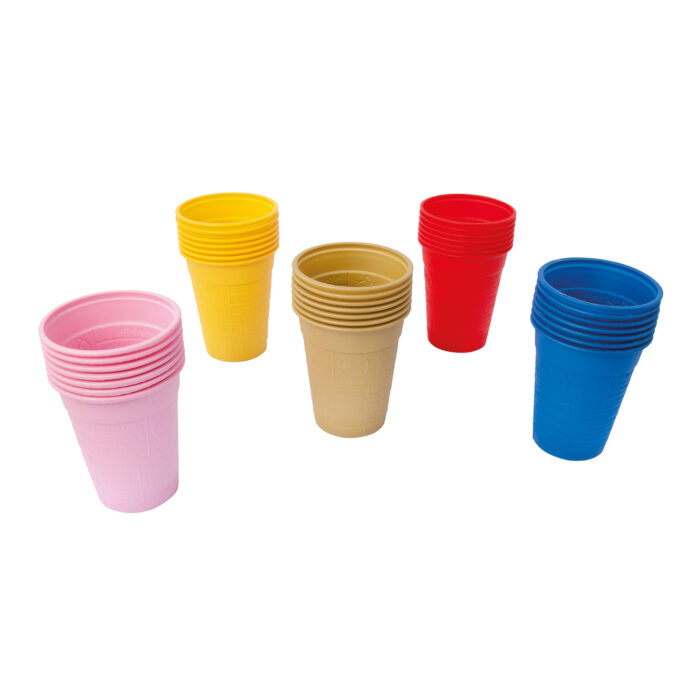
From here our organic products were “born”/founded, which over the years have increased in production and variety offered: from trays to bibs, from sponges to bibs, from glasses to dappens.
We strongly believe in daily work in line with the “Green Economy” and I do not consider it an abstract concept but a fundamental value that guides choices at both a corporate and personal management level.

If we decided to throw ourselves into the world of Bio Materials in the dental field it is also thanks to the new generation, who are increasingly interested in having the minimum negative impact on the environment: right from the start I believed that this was the right path and in fact, especially in recent years, the general trend has confirmed this.
Bio Materials and innovation for the dental professionals today and tomorrow
The future of Bio Materials? Absolutely thriving and increasingly successful. The forecasts say it, the young dental professionals confirm it. Now there is no time left not to act concretely for the environment and in our small contribution we can all make a big difference.
In the short term I hope that products based on Bio Materials will become increasingly popular so as to be able to reduce production costs and thus become increasingly accessible.
In the long term the hope is that we will continue to experiment and do research both in the application of Bio Materials and in the production with these materials but above all that this research can open up new scenarios for dental and healthcare treatments.