


The domino effect: why the DA crisis is costing you 15% of your patients
Have you lost a Dental Assistant (DA) in the last 12 months? If so, you are in good company. The Dental Assistant crisis in dental practice is a real challenge.
If you think the problem is “theirs”—a low salary, a personal matter, or a lack of resilience—you are mistaken. The issue is structural, systemic, and above all, it is costing your practice more than you realize.
Let’s talk numbers, because numbers don’t lie.

The data no one has told you about the Dental Assistant crisis
From the fast track to an endless waiting list: between 2014 and 2022, Italy lost 30% of its DA workforce. The number of Dental Surgery Assistants dropped from approximately 95,000 to fewer than 70,000, according to Ministry of Health data cited by ANDI.
In eight years, 25,000 professionals have vanished from our industry. Retirements, maternity leave, early career exits, and low enrollment in certification courses have created a heavily negative balance, and in 2026, the situation has not improved.
What does this mean for your practice?
- Up to 15% of your patients leave when a Dental Assistant departs; they often follow the assistant because of the trust established.
- Productivity plummets by 30-50% during every staff transition phase.
- The direct cost of each replacement is between €2,000 and €5,000 in recruitment and selection, plus 2 to 4 weeks of training on internal procedures and assessment.cedure interne e assestment.
These are exorbitant figures. This isn’t just an “assistant problem”; it becomes a problem of governance, revenue, and clinical reputation for the entire practice.
The domino effect you only see when it’s too late
Imagine a practice with three chairs and two Dental Assistanta. One resigns. The other takes on double the workload.
The dentist starts doing everything: sterilization, front desk, calendar management. Procedures slow down. Delays accumulate. Patients wait longer, receive a poorer welcome, and get less attention.
Perceived quality drops—and in dentistry, perceived quality is everything. One in six patients won’t re-book. They don’t complain; they simply don’t come back. Meanwhile, the remaining DA watches. They feel the worsening climate and the burnout in the air. They start looking at job offers on LinkedIn. The dominoes continue to fall.
Vicious Cycle of Understaffing
- Dental Assistant Shortage → Unsustainable workload for remaining staff
- Unsustainable Workload → Drop in perceived service quality
- Declining Quality → Patient loss (up to 15%)
- Lost Patients → Reduced revenue and amplified owner stress
- Owner Stress → Further team resignations
- New Recruitment/Training Cycle → And it starts all over again
The multitasking dentist burnout: the risk you’re ignoring

Let’s talk about the dentist. You are a professional with high-level clinical training. Every hour you spend operating on a patient is statistically worth between €150 and €400 in value produced.
Every hour you spend sterilizing instruments, answering phones, or updating charts is worth… zero.
Yet it happens every day in thousands of Italian practices—perhaps even yours. According to Fnomceo surveys, 3% of dentists declare full-blown burnout, but post-pandemic meta-analyses estimate high levels of depression and anxiety in over 15,000 dentists—a vastly underestimated phenomenon. Practice owners are the most exposed, crushed between clinical responsibility and business management.
Symptoms of the “Multitasking Dentist”:
- Finding yourself doing tasks you shouldn’t be doing.
- Having less energy for complex patients or continuing education.
- Your high-value clinical time has progressively shrunk.
- Feeling like you are “plugging holes” rather than building a practice.
- Staff management takes more energy than clinical work.
This is a direct consequence of the DA crisis in your dental practice.
How technology and ergonomics become your allies
Now for the solutions. They exist, and they are more accessible than you might think.
When an Dental Assistant leaves, most owners rush to hire a replacement to avoid “drowning” without asking why the previous one left. It is often assumed that the solution is purely financial: “increase the salary, solve the problem.”
In reality, GenZ and Millennial professionals today evaluate employers based on very different criteria than twenty years ago:
- Work Environment: Stimulating, focused on professional/personal growth, modern, and sustainable.
- Tools: High quality, but above all ergonomic, respecting natural gestures and posture.
- Training: Continuous, comprehensive, and up-to-date.
- Atmosphere: Positive, constructive, and highly organized.
This is where technology and ergonomics serve as team management tools, not just clinical choices.
Do ergonomic tools reduce Dental Assistant burnout?
An assistant working all day with heavy, poorly balanced, or noisy tools accumulates physical and cognitive stress. Musculoskeletal disorders are among the leading causes of early exit from the profession.
Investing in ergonomics is not an aesthetic whim: it is turnover prevention. Clear protocols and easy-to-sterilize, well-organized tools reduce mental load and errors. A team that works fluidly is a more serene team—and harder to lose.
Organizational ergonomics: when color becomes a protocol
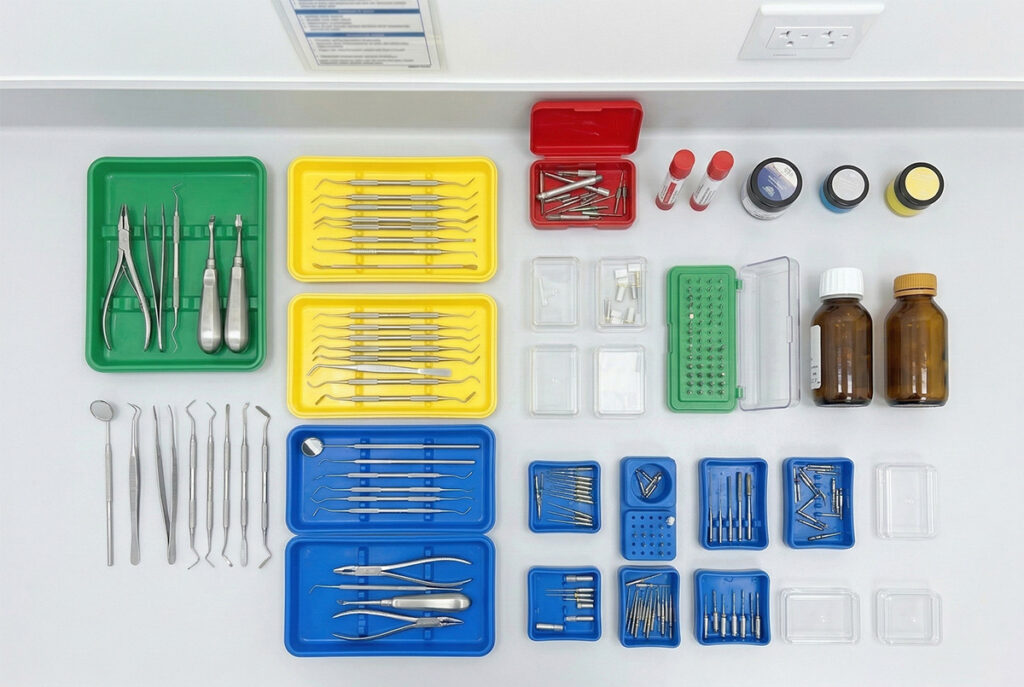
Efficient practices use organizational ergonomics: designing the workflow so that errors become structurally difficult to commit.
A practical example? Instrument color-coding systems. Assigning a color to each category of instruments, patient, procedure, or sterilization level transforms a written protocol into instant visual information. The Dental Assistant doesn’t have to remember or ask; they see.
The concrete benefits of a color-coded system include:
- Setup Speed: The right tray is recognized in a second.
- Reduced Cross-Contamination: Color-per-chair or patient makes anomalies immediately visible.
- Faster Onboarding: A new Dental Assistant learns protocols in half the time when the visual system does the work for them.
- Less Multitasking Stress: Every decision removed from working memory is mental energy saved for what matters.
The future: transform your practice into a talent magnet
Employer Branding. In 2026, this is the differentiator between practices that grow and those that merely survive. The question isn’t “How do I find another DA?” but “How do I make the best DAs want to work here?”
The 5 Levers of employer branding for your practice:
- Internal Reputation: Your reputation as an employer travels faster than any ad through WhatsApp and professional groups. Work on the climate first.
- Training as a Benefit: Practices that invest in training see a 70-80% reduction in turnover and a 15-20% ROI on productivity (Source: AIO, 2024).
- Flexible Welfare for GenZ: Flexible hours and “smart working” for admin tasks. 82% of top healthcare firms use active retention plans.
- Environment as a Statement: High-quality ergonomic carts and tools communicate that you value your team’s work.
The issue with Dental Assistants is a problem for the entire team.
The Dental Assistant crisis is a structural transformation of the labor market. Practices that treat it as a “hiring problem” will pay the price in lost patients and burnout. Those who see it as an opportunity to redesign their organizational model with new tools and a new culture will emerge stronger.
Team management is as clinical as treating teeth. Treat it as such.
Explore our line of Made in Italy ergonomic products
Discover how our tools can contribute to your practice’s organizational well-being!
FAQ – Dental Assistant (DA) Crisis and Team Well-being
Replacing an Dental Assistant costs between €2,000 and €5,000 in recruitment, plus 40-80 hours of training. Indirectly, you can lose up to 15% of your patients and see a 30-50% drop in productivity during the transition. Total damage can exceed 15-20% of annual revenue.
Prevention requires clear protocols to make the team autonomous, investing in Dental Assistant retention (welfare and growth) to ensure stability, and adopting ergonomic tools/visual coding to lower the collective mental load.
Focus on internal climate (reputation), build explicit growth paths (using AIO-Fisascat CCNL tools), and implement flexible welfare. These steps can reduce turnover by 70-80%.
Larident works on two levels: Physical (balanced, Made in Italy instruments that prevent occupational diseases) and Organizational (color-coding systems that reduce cognitive load, speed up setup, and accelerate onboarding for new staff).